Client stories

Structure, clarity and alignment, in practice.

How we've helped teams across industries bring structure, clarity and alignment to the way they work. Filter by focus area, or open any case to read the full story.

Global NGO

Greenpeace International

Work Management

Consistent Asana across global teams, to enable asynchronous work across continents and time zones.

AsanaGTDAsync teamworkProgram design
Read the story
Greenpeace logo

Global Collaboration Expert

Global NGO

Greenpeace had invested in a full collaboration toolset, Asana, Slack, Zoom and Google Workspace, but teams used them unevenly. With high workloads and constant tool-switching, too much of people's energy went into work about work instead of the campaigns themselves. Over a ten-month engagement, I worked as Greenpeace's global collaboration expert on their CollabLab initiative, working closely with the global CollabTools team (sitting across Global IT and L&D).

The challenge

Teams spread across continents and time zones needed to work asynchronously, but Asana adoption was inconsistent, information lived in too many places, and meetings and email kept piling up. The aim was to shift daily brain space away from coordination and back towards creative, productive work.

What we did

We focused on working practices first and treated the tools as the means, not the goal. The programme rested on three practices:

  • Getting Things Done, for personal work management
  • Asynchronous working: clear channels, strong documentation, and shared working agreements
  • Workflows, automations and templates in Asana

Developing the programme. Beyond coaching, I co-developed CollabLab's core programme: a modular, three-step team journey (Getting Started, Getting Better, Optimizing) plus a self-guided individual track. I shaped how it was positioned and pitched to teams, built around habit-forming and different learning styles, so a team could start with the part that fit them and still work towards the whole.

Coaching teams. Working team by team, I ran pilot programmes of around three months. Each covered:

  • Project setup sessions and Asana set-up, alongside Slack and Google Drive
  • A RASCI per team, to clarify who is responsible for what
  • A Comms Charter, a template I built so each team could agree which tool to use for what and when, plus tone of voice and team communication best practices
  • Async collaboration principles
  • Team training, plus 1:1 Asana and GTD coaching

Building reusable materials. So the work could scale beyond the teams I coached directly, I created:

  • Asana Project Basics, a training and self-paced e-course
  • WorkLight, a self-paced habit programme in the Greenpeace Academy, teaching personal work management based on GTD
  • Repeatable Asana team trainings
  • A bi-weekly Asana Inspiration Session and community call

Finally, I trained internal champions and handed the programme over to the in-house CollabTools team to carry forward.

The result

A repeatable collaboration programme with its own library of trainings, e-courses and templates. Pilot teams moved towards async-first ways of working, clearer Asana structure (goals, projects and tasks), and fewer, sharper meetings. The work fed directly into Greenpeace's wider Digital Transformation pilots on reducing meeting time and improving asynchronous collaboration.

What people said about the Asana Project Basics training
"Really good to have concrete examples from the Greenpeace world to explain Asana concepts. I found Asana's own materials always too broad and not opinionated enough."
"I like the way it relates projects to Greenpeace, with campaign data and real-life examples that help people visualise their work in Asana."
"A good overview of what Asana can do, with a nice explanation of the jargon and examples to illustrate the points. Very informative, and it piques your interest to learn more."
"The information is laid out clearly. It defines what each function in Asana is and its best use case, which helps a team start to visualise their workflow."
"Great course, loved how simple and quick it is."

Insulation manufacturing

Kingspan-LOGSTOR

Work Management

One standardised Asana workflow for complex international tenders, with OKRs tracked in Asana Goals alongside the work.

AsanaOKRsTemplates
Read the story
Kingspan LOGSTOR logo

External Asana Consultant

Insulation manufacturing

Kingspan LOGSTOR wins and delivers large international tenders, work that pulls teams across several countries through a long chain of cross-functional reviews and handovers. All of it ran on Excel and email, where ownership and progress were easy to lose. I worked with the LOGSTOR Benelux team as their external Asana consultant to turn that tender process into one standard, repeatable workflow, and to bring their OKRs into the same place.

The challenge

A single tender moves through many hands and many documents, across countries and teams, with each step tracked in spreadsheets and inboxes. Tasks lost their owner, progress was hard to see, and handovers slipped. LOGSTOR wanted one standard way to run a tender, with clear ownership and progress at every step. They also wanted to set and track their OKRs in Asana Goals, rather than in a separate system.

What we did

  • Mapped the tender process and built a standard Asana template for tenders and handovers, so every tender runs the same structured way
  • Built templates for recurring internal projects too, like a reusable trade-fair template the office team could run for every event
  • Replaced scattered Excel trackers and email threads with one shared view of ownership and progress
  • Ran OKR training, then set up and integrated their OKRs into Asana Goals, connecting the relevant projects and tasks so progress rolls up from the daily work
  • Introduced portfolios and internal usage guidelines, plus 1:1 coaching and hands-on support, as a focused pilot before a wider rollout

The result

A clear, repeatable structure for complex, multi-country tenders, with far less reliance on Excel and email. Ownership and progress became visible at every step, OKRs lived alongside the work they measured, and the pilot gave Kingspan a scalable foundation to take the approach wider.

Online food delivery

Just Eat Takeaway

Work Management

A full Asana setup for a marketing team drowning in email and spreadsheets, with personal-work coaching to match.

AsanaGTDTemplates
Read the story
Just Eat Takeaway logo

Asana Consultant & Trainer

Online food delivery

An Amsterdam-based marketing team at Just Eat Takeaway, running campaigns for the Swiss market, had just moved to Asana while the departments around them were already using it. Their work was scattered across email and spreadsheets, things were falling through the cracks, and the team felt stretched and overwhelmed. I ran a full Asana implementation with them, then coached people one to one on their personal way of working.

The challenge

The team needed to plan campaigns, handle a steady stream of translation requests, and onboard new hires, all without a shared system. Work lived in inboxes and spreadsheets, there was no clear overview, and they needed to collaborate smoothly with departments already working in Asana. The goal was structure, shared processes, and less stress.

What we did

  • A full Asana implementation: discovery, setup sessions and team training
  • A campaign-planning system with built-in approval flows, so campaigns run to a repeatable structure
  • A Forms-based intake for translation requests, with automations to batch and organise the work in one place
  • 1:1 coaching in personal work management, using GTD, to clear the mental clutter

The result

Less overwhelm and more clarity, smoother collaboration with the wider organisation, and a team confident using Asana to run their work. Campaigns, translations and daily tasks moved out of email and into one shared, structured place.

What the team said

"My main takeaway was the GTD method, combined with executing it in Asana, plus the inspiration on all the different ways to use Asana."
Yannik Köchy, Marketing Executive
"I can use Asana to empty my mind much more. I used to forget little things, and that got a lot better. The training helped me get better structure into my day-to-day work, and the 1:1s take off the stress of getting my templates perfect on day one."
Franziska Walder, Marketing Manager

Furniture design studio

Studio HENK

Work Management

An Asana rebuild that pulled a design studio's work out of endless subtasks and into clear, repeatable templates.

AsanaGTDTemplates
Read the story
Studio HENK logo

Asana Consultant & Trainer

Furniture design studio

Studio HENK, an Amsterdam furniture design studio, wanted to run their design and product development in Asana, and to get their marketing team organising campaigns there too. Marketing was where most of the work happened, and it had ended up buried in subtasks: subtasks of subtasks of subtasks, the kind of rabbit hole where the overview disappears. I rebuilt their setup so the work was visible again, then trained the team to keep it that way.

The challenge

Almost everything lived inside subtasks, stacked so deep that no one could see what was actually happening. The team had also been trying to fit too much into single projects, out of a worry about creating too many. They needed a clear structure, real overview, and repeatable ways to run content, campaigns and launches.

What we did

  • Pulled the real work out of buried subtasks and up into main projects, so it was visible and trackable
  • Introduced clear project separation, replacing the one-giant-project habit
  • Built a connected system of templates for the content calendar, social media, and campaigns from evergreen to seasonal to new-product launches
  • Used custom fields, rules and multi-homing so every step, from briefing to studio work to execution, had its place and nothing got forgotten
  • Started with discovery and project-setup sessions, and finished with an Asana x GTD training for personal work management

The result

A full Asana rollout across the design and marketing teams, with structured, repeatable workflows. Work that used to vanish into subtasks became visible and easy to follow, and the studio had a watertight template system that made sure nothing in a launch slipped.

What the team said

"10/10 would recommend. Anne Nynke is a great presenter, and gives a good introduction to GTD. An interesting and helpful method. What I valued most was seeing how she applies GTD in her own life."
Emma van den Berg, Brand Manager

Property development & childcare

Blockworks

Work Management

A full Asana setup for a UK property developer, plus OKRs and tactical meetings, to bring structure to complex building projects.

AsanaOKRsTactical meetings
Read the story
Blockworks logo

Asana Consultant & Trainer

Property development & childcare United Kingdom

Blockworks, a UK company, builds and renovates property into housing, schools and children's care units, and runs children's nurseries of its own. They had been using Asana for about a year, but unevenly: the structure was messy, knowledge was patchy, and powerful features like Goals were going unused. They wanted someone to look at how they'd set things up, train the team properly, and finally get OKRs running in Asana Goals. The work grew into three strands: Asana, OKRs and tactical meetings.

The challenge

Everyone used Asana a little differently. Some knew only the basics, no one used the full toolset, and the underlying structure was too loose to manage complex, long-running building projects, from buying land, to financing with banks, to a twelve-month build. They were on a premium plan with Goals but not using it, and they needed a shared, consistent way of working that could also stand up to the standards their children's care projects had to meet.

What we did

Asana

  • Ran discovery, an Asana Essentials training, and hands-on project setup support
  • Standardised project structure across teams, with a library of templates, including ones built to cover everything needed for an Ofsted "outstanding" rating on their care projects

OKRs

  • Ran an OKR introduction and a goal-setting session, set up in Asana Goals, with follow-up support and coaching

Tactical meetings

  • Introduced a tactical meeting rhythm, facilitated their meetings, and coached a future in-house facilitator one to one

The result

Clearer alignment across teams, structured execution on complex projects, and proper use of Asana's features, Goals included, across departments. Blockworks moved from an uneven, improvised setup to a shared way of working, with OKRs to align on priorities and a meeting rhythm to keep delivery on track.

Global NGO

Greenpeace International

Strategy Execution

One standard OKR approach across Greenpeace's global tech department, set and tracked in Asana Goals so team goals ladder up to the department's.

OKRsAsana Goals
Read the story
Greenpeace logo

OKR Consultant & Facilitator

Global NGO

While I was already working with Greenpeace as their external collaboration expert, the technology department asked me to take on a second assignment: helping their global tech function get better at OKRs. I worked with the CTO and global tech directors to shape the approach, then ran pilots with teams and trained them myself to align their own goals to the department's. They wanted their OKRs to live in Asana Goals rather than a separate tool, so progress could be followed asynchronously across time zones.

The challenge

Across the technology department, teams were already using OKRs, but every unit did it its own way. There was no shared standard for setting goals, aligning them, or tracking progress, so priorities were hard to see across a globally distributed organisation. Leadership wanted one consistent approach, clear ownership, and an agreed way to measure progress and impact.

What we did

  • Facilitated goal-setting sessions where the department drafted its own objectives and key results, building the skill to do it well
  • Co-designed a standard OKR framework so every team worked the same way
  • Set up the OKRs in Asana Goals, with clear ownership and timelines
  • Helped each team align its OKRs to the department's, and connect day-to-day work to those goals so progress rolls up
  • Created templates and onboarding materials for future cycles, and supported adoption with check-ins, reviews and coaching
  • Trained an internal champion to run the OKR cycle after the engagement ended

The result

A single, shared way of setting and tracking goals across the technology department, replacing the patchwork of unit-by-unit approaches. Team OKRs now ladder up to the department's, daily work connects to the goals it serves, and an internal champion keeps the cycle running. The process lives in Asana Goals and is used for planning and reviews.

E-commerce

Bol.com

Strategy Execution

A company-wide OKR rollout for Bol.com (around 2,000 people), replacing yearly OGSM plans where the real priorities got lost.

OKRsAlignment
Read the story
Bol.com logo

OKR Consultant

E-commerce

Bol.com, one of the Netherlands' largest online retailers, asked me to help move them from yearly OGSM planning to OKRs: a company-wide implementation across roughly 2,000 employees. The harder part was making it work across an organisation that wasn't even planning to the same rhythm. I helped them design, pilot and roll out the shift.

The challenge

Each department sent a yearly OGSM one-pager, but in practice those arrived as long slide decks packed with so many measures that the real priorities disappeared. The yearly department plan also sat too far from the teams doing the work, so people struggled to see how their day-to-day affected it, and many already wanted shorter, bottom-up goals they could act on. On top of that, half the organisation planned in quarters and the rest in trimesters, so there was no shared cadence to hang goals on.

What we did

  • Gathered a team of internal stakeholders and changemakers to drive the rollout
  • Ran a pilot with multiple teams across departments
  • Set department OKRs top-down and team OKRs bottom-up, aligned to each other
  • Built on their existing internal Way of Working team, training the WoW coaches to support teams with OKRs too
  • Led a tool-selection process across departments including IT Security, Procurement and Legal
  • Developed a custom in-house OKR e-learning, so the approach could scale

The result

Bol.com went from one yearly department OGSM to a living OKR cycle teams could actually work with. Department goals set the direction top-down, team goals align to them bottom-up, and each team links its own work to the OKRs it contributes to. The rhythm fits how the business runs: a trimester cycle for commerce teams, quarterly OKRs across the rest of the organisation. With trained internal Way of Working coaches and an in-house OKR e-learning, they were equipped to keep the cycle going without further outside help. Triple Nine helped Bol.com roll OKRs out to around 2,000 people, and more than five years on Bol is still working with OKRs, having since brought the whole organisation onto one quarterly rhythm.

Sustainable mobility

MisterGreen

Strategy Execution

An OKR programme for MisterGreen's leadership, equipping every manager and team lead to run OKRs with their own teams.

OKRsAsana GoalsAlignment
Read the story
MisterGreen logo

OKR Trainer & Coach

Sustainable mobility

MisterGreen, a sustainable mobility company built around electric-car leasing, first brought me in for a focused Asana project: building project setups and workflows for some of their high-priority leadership work. When that wrapped up, they asked me back for a separate, larger assignment, implementing OKRs across the business. For the OKR work we took a leadership-first route: instead of training individual teams, I worked with the management team and all the leads, so each manager could carry OKRs into their own team. I shaped the programme around what their CCO and CFO wanted it to achieve, and ran it over several sessions.

The challenge

The aim was to bring every lead to a shared level of understanding of OKRs: from not really getting them to writing, owning and using them with their teams. Some leads doubted OKRs even fitted their work, especially outside sales and marketing. There was plenty of activity, much of it already in Asana, but no clear objectives and no shared way to see whether the company was moving forward.

What we did

  • Started the relationship with a separate Asana engagement: project setups and workflows for high-priority leadership work
  • Ran the OKR programme with managers and leads over several sessions: company OKRs first, then team OKRs, then linking each team's daily work to its OKRs
  • Taught the craft of good OKRs, objectives versus key results versus outputs, and the difference between KPIs and OKRs, using their own data
  • Set their OKRs up in Asana Goals, with owners, context and health metrics
  • Ran a regular check-in rhythm, plus a retrospective review of the previous quarter's OKRs, so they stayed live rather than set and forgotten
  • Had each lead draft their next quarter's OKRs and present them back, so the learning landed in real plans

The result

By the end, the leads could write an outcome-focused OKR, align it to the company's goals, and run it with their team in Asana. OKRs went from a sceptical "does this even apply to us" to a working rhythm of objectives, check-ins and reviews. Teams turned busy task lists into measurable outcomes and could finally see their progress, and even early doubters came round.

What the team said

"Very informative sessions, with a great framework to work from."
Austin Mohler, Lead Customer Success
"OKRs were new to me. Anne taught us the ins and outs in a fun way. Now it's up to us."
Coen, Lead Inside Sales
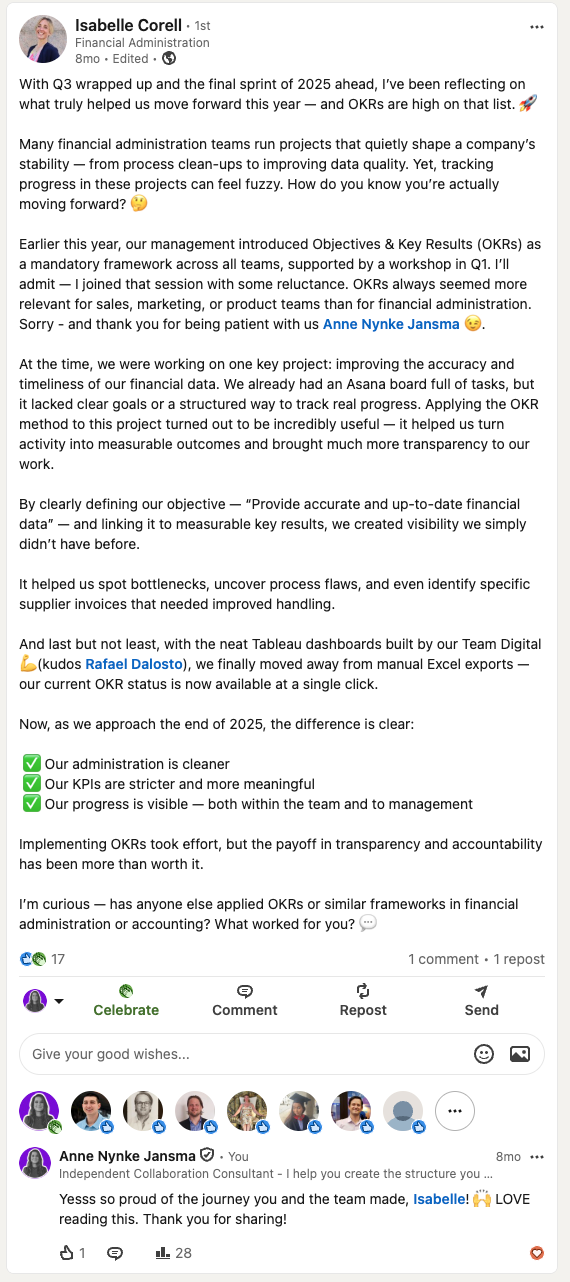
"Applying the OKR method turned out to be incredibly useful. It helped us turn activity into measurable outcomes and brought much more transparency to our work. The payoff in transparency and accountability has been more than worth it." Isabelle Corell, MisterGreen LinkedIn post by Isabelle Corell of MisterGreen describing how the OKR rollout turned activity into measurable outcomes and improved transparency and accountability
From Isabelle Corell's LinkedIn post about the OKR rollout. Click to enlarge.

Social entrepreneurship & NGO

Social Innovation Academy

Strategy Execution

An introduction to OKRs for a Holacracy-run academy, giving a driven, self-organised team a shared way to set and align goals.

OKRsAlignmentHolacracy
Read the story
SINA logo

OKR Trainer & Facilitator

Social entrepreneurship & NGO Uganda

SINA, the Social Innovation Academy in Uganda, runs on Holacracy: a self-organised structure of circles and roles rather than a traditional hierarchy. They had seen how OKRs could plug into that structure and wanted to bring the two together, so a driven, fast-moving team could agree on what mattered most and aim at it together. I ran an introduction to OKRs with them, facilitated online for a team that was partly together on the ground in Uganda and partly dialling in from other countries. Folding OKRs into a self-organised setup was familiar territory for me, I'd done it for four years while working at Springest.

The challenge

A self-organised team with plenty of drive and ideas still needed a shared way to point all of it in one direction. Without a common method for setting goals, people could each pursue what mattered to them without a clear view of the organisation's top priorities. They wanted OKRs to give their circles and roles a way to align on what to achieve and to measure progress, all without breaking the self-organised way they work.

What we did

  • Ran an introduction to OKRs, facilitated online for a team partly on the ground in Uganda and partly remote
  • Built the session around the participants' own real goals, so the method felt concrete and relatable
  • Covered the essentials: why OKRs, the difference between outputs and outcomes, and how to write measurable key results
  • Showed how OKRs fit a Holacracy structure, plugging into circles and roles rather than cutting across them
  • Offered follow-up support afterwards, giving feedback on the OKRs they drafted to help finetune them

The result

SINA came away with a shared destination to work towards together, and a first grasp of OKRs they could keep building on. The training gave their energy a common direction. For a team used to working without top-down direction, it offered a way to align on shared priorities while keeping their autonomy intact.

What the team said

"In SINA we are all very excited about the work we do. Sometimes it feels like a lot of very, very fast boats going in different directions, because we don't know how to channel our energy. The OKR training really supported us to identify a common destination we want to go to together as a team."
Maike Striffler, Acceleration Lead
"I liked Anne's way of including the participants. Especially in an online facilitated session this isn't always easy. Building on real cases of participants and going forward from there made it easier to connect to the process."
Philipp Mäntele, SINA
"I enjoyed the introduction to OKRs and would recommend it to anyone beginning with this setup. Very straightforward, with good examples and exercises."
Anonymous, SINA volunteer

Mental healthcare

NL Mental Care Group

People Enablement

A self-organising way of working for 45 mental-healthcare teams, with clear roles, tactical meetings and open governance, so each team could run itself.

Self-organisationRole structureTactical meetingsOpen governance
Read the story
Mentaal Beter logo

Self-Organisation Trainer & Facilitator

Mental healthcare

NL Mental Care Group, the organisation behind Mentaal Beter, Opdidakt, Vitalmindz and other mental-healthcare labels, was acquiring psychologist practices all over the country. The group already ran on a Holacracy-inspired way of self-organisation, and each newly acquired practice had to learn it from scratch and become part of it. I helped them make that shift team by team, giving each one clear roles, a tactical meeting rhythm, and a way to govern itself.

The challenge

Bringing dozens of newly acquired practices into an established self-organising way of working is a big ask. Coming from traditional structures, teams had to learn a whole new way of operating. Without clear roles, it is easy to lose track of who is responsible for what: work slips through the cracks ("I thought you had it"), decisions slow down, and leaders become bottlenecks. Each team needed to learn to run itself, clear on its responsibilities, able to make its own decisions, and able to change how it works without waiting on the top.

What we did

  • Built a role-based structure for each team, so everyone knew what they owned and, just as usefully, what they did not
  • Ran a training programme, a set of "driving lessons", that taught each team the tactical meeting structure and let them practise it
  • Introduced open governance, so any team member could propose a change and process it through reactions and objections until the team adopted it
  • Coached the Facilitator and Secretary roles one to one, and trained Regional Directors in the leadership skills the new way of working needed

The result

45 teams adopted the new way of working, each with its own clear roles, a (bi-)weekly tactical meeting to run operations, and open governance to evolve how they work. Team members were empowered to make their own decisions and to reshape their own structure, with far less reliance on managers to unblock them. What started as a way to absorb new practices became a shared operating model across the group.

E-commerce

Bol.com

People Enablement

A redesigned onboarding journey for Bol.com, from two days of back-to-back presentations to a three-month pathway to welcome 40-60 new hires every month.

OnboardingProgram design
Read the story
Bol.com logo

Employee Onboarding Consultant

E-commerce

Bol.com was hiring fast, 40 to 60 new people every month, and onboarding them with two solid days of back-to-back presentations: department after department explaining what they do. It didn't scale, it was a lot to take in at once, and it no longer matched how Bol actually worked. They wanted an onboarding experience that was interactive, scalable, and true to their culture. I helped them redesign it from the ground up.

The challenge

Two days of presentations is hard to keep up when you're onboarding dozens of people a month, and even harder to absorb. New hires were flooded with information on day one and remembered little of it, and the format didn't reflect Bol's own way of working. The redesign had to scale with their hiring, spread the learning out, and actually help people feel part of the company.

What we did

  • Audited the existing programme and how new hires experienced it
  • Ran focus groups on three levels: what the organisation wants new hires to know and feel, what hiring managers need from them, and what recent joiners wish they'd been told, so the redesign was built on real needs
  • Piloted new ideas before committing to them
  • Designed a new onboarding pathway from the findings

The result

A redesigned onboarding journey spread across three months instead of crammed into two days, and English-first, so no one needed a translator in the room. New hires move through it in onboarding groups, with a mix of live and online sessions, a buddy to lean on, and even an office scavenger hunt, learning the company gradually and feeling part of it from the start.

Want results like these?

Book a free intro call and tell us what you're working on.